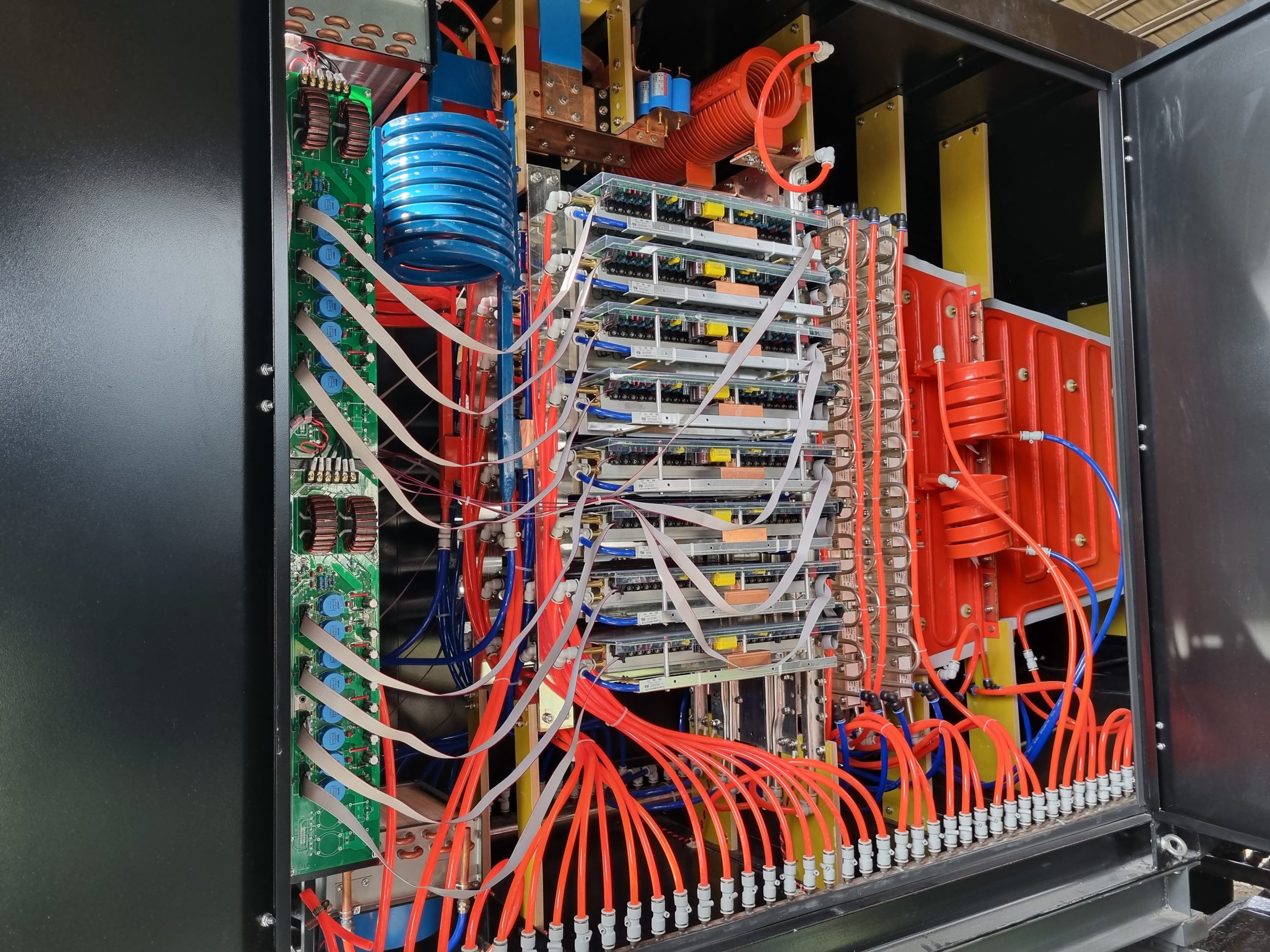
High Frequency Welding System
High-Frequency Induction Welding Systems
Producing high-quality steel tubes and pipes is virtually impossible without advanced welding technology. Among the various metal joining methods available today, High-Frequency Induction Welding (HFIW) has become the industry standard for tube and pipe manufacturing due to its high production speed, consistent weld quality, excellent energy efficiency, and seamless integration into continuous production lines.
Unlike conventional welding methods, HFIW generates the required heat without direct contact with the workpiece. Instead, an electromagnetic field induces heat precisely at the weld zone, enabling highly controlled, energy-efficient, and repeatable welding performance.
Today, virtually every modern tube and pipe mill relies on High-Frequency Induction Welding systems to achieve superior product quality and maximize production efficiency.
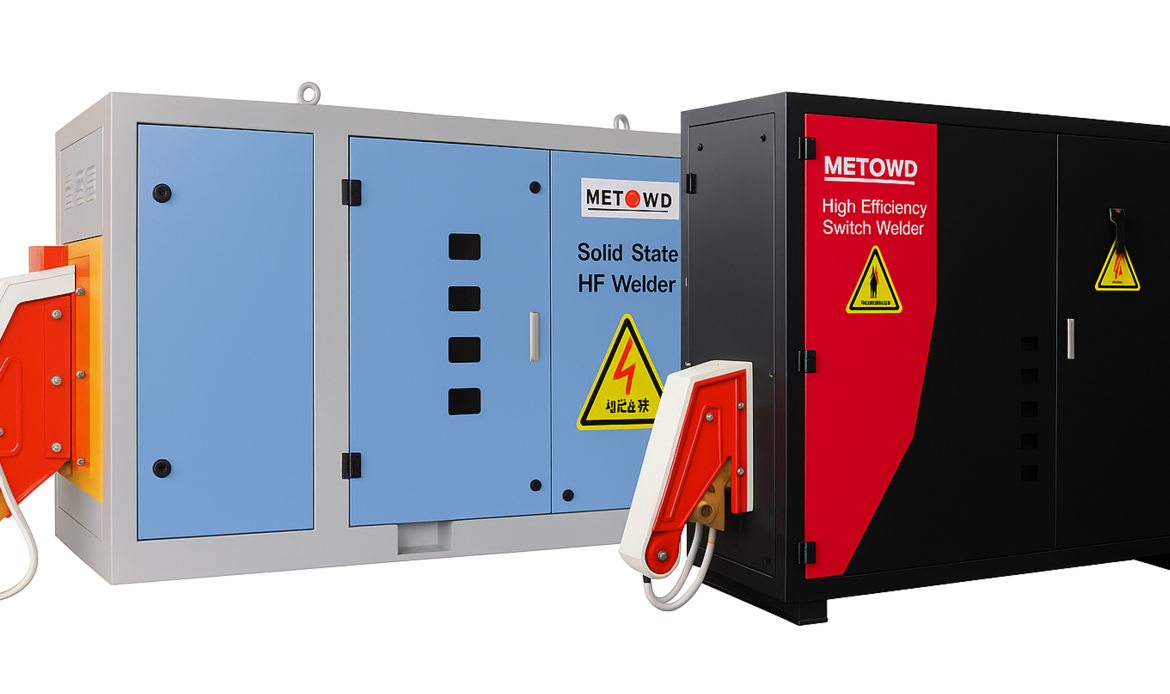
A Brief History of High-Frequency Induction Welding
The use of induction energy for heating metals dates back more than a century, while its industrial application in tube manufacturing expanded rapidly during the 1950s.
The first generation of high-frequency welders utilized Vacuum Tube power supplies to generate high-frequency current. Although these systems revolutionized tube production at the time, they suffered from several limitations, including high power consumption, large equipment size, intensive maintenance requirements, and relatively low operational efficiency.
The development of power semiconductor technology led to the introduction of Solid State High-Frequency Welders, which significantly improved efficiency while reducing energy consumption, maintenance requirements, and operating costs. These systems also offered greater reliability and more stable welding performance.
Subsequent advancements in MOSFET and later IGBT technologies enabled more precise power control, faster switching speeds, and higher output capacities.
Today, leading manufacturers such as Metowd offer a comprehensive range of High-Frequency Induction Welding systems designed to meet the diverse requirements of modern tube and pipe production lines.
How High-Frequency Induction Welding Works
During the tube forming process, the steel strip is progressively shaped into a cylindrical profile, bringing the strip edges into close proximity before welding.
The High-Frequency Induction Welder converts electrical power into high-frequency current, which is delivered to an induction coil positioned around the weld area. The resulting electromagnetic field induces electrical currents along the strip edges.
Due to the Skin Effect and Proximity Effect, the induced current becomes highly concentrated at the strip edges, generating localized heat exactly where welding is required.
As the heated edges pass through the squeeze rolls, controlled pressure forges them together, producing a strong, uniform metallurgical bond without the need for filler materials.
Accurate control of output power, operating frequency, and energy concentration is essential for achieving consistent weld quality, maximizing production speed, and minimizing scrap. Consequently, selecting the appropriate welding system is one of the most critical factors influencing the overall performance of a tube and pipe production line.
Types of High-Frequency Induction Welders
Continuous advances in power electronics have transformed High-Frequency Induction Welding technology over the past several decades. Each new generation has been developed to improve efficiency, reduce energy consumption, enhance weld quality, and minimize maintenance costs.
Today, selecting the right welding system depends not only on power output but also on production capacity, tube dimensions, material characteristics, and operating conditions.
Vacuum Tube Welders
Vacuum Tube Welders represent the first generation of high-frequency welding equipment used in tube manufacturing.
Although they played a significant role in the early development of the industry, their high energy consumption, bulky design, frequent maintenance requirements, and limited process control gradually led to their replacement by modern solid-state technologies.
Solid State HF Welders
The next generation introduced power semiconductor technology, giving rise to Solid State High-Frequency Welders.
Compared with vacuum tube systems, these welders provide substantially higher efficiency, improved operational stability, lower maintenance costs, and greater reliability.
Today, Solid State HF Welders have become the industry standard and are available in a wide range of power ratings suitable for both small production facilities and heavy-duty tube mills.
High Efficiency Switch Welders
This generation utilizes advanced switching technology and optimized power circuit design to achieve even higher energy efficiency than many conventional Solid State systems.
Key advantages include reduced electrical consumption, greater welding stability, and reliable continuous operation.
According to Metowd, this technology can achieve overall system efficiencies of up to 90%, while significantly reducing energy consumption compared with conventional Solid State welding systems.
SiC-Based Welders
The latest generation of High-Frequency Induction Welders incorporates Silicon Carbide (SiC) semiconductor technology.
SiC devices enable faster switching frequencies, lower power losses, reduced heat generation, higher efficiency, and more compact equipment designs.
These systems are particularly suitable for modern production lines requiring maximum reliability, continuous operation, and outstanding energy performance.
Leveraging these technological advancements, Metowd has developed a comprehensive portfolio of High-Frequency Induction Welding systems covering a wide range of power ratings for virtually every tube and pipe manufacturing application.
Metowd High-Frequency Induction Welding Systems
Specializing in the design and manufacture of High-Frequency Induction Welding equipment for tube and pipe production, Metowd offers a complete range of advanced welding solutions for small, medium, and high-capacity production lines.
Each system is engineered to deliver consistent weld quality, maximize energy efficiency, improve production performance, and simplify maintenance.
Solid State HF Welders
Metowd’s Solid State HF Welders represent the modern replacement for traditional vacuum tube welding equipment.
By utilizing advanced power electronics and intelligent control systems, these welders provide stable, consistent, and high-quality welding performance across a wide range of production conditions.
Key benefits include:
High electrical efficiency
Reduced energy consumption
Compact equipment design
Low maintenance requirements
Excellent operational reliability
Multiple power ratings for various production capacities
High Efficiency Switch Welders
Designed to maximize production efficiency while reducing operating costs, this product family incorporates advanced switching technology together with optimized power conversion architecture.
The result is higher system efficiency, lower power losses, improved welding stability, and reliable continuous operation.
These systems are ideally suited for production lines where high productivity, reduced energy consumption, and consistent weld quality are primary objectives.
SiC Switch Welders
Metowd’s latest generation of High-Frequency Induction Welders is built around advanced Silicon Carbide (SiC) technology.
The use of SiC power semiconductors enables faster switching speeds, significantly lower power losses, reduced heat generation, and improved overall system efficiency.
Designed for next-generation tube and pipe mills, these systems deliver exceptional reliability, maximum energy efficiency, and continuous high-performance operation, representing the latest evolution in High-Frequency Induction Welding technology.